 Skip-the-line available
 The Best Time to Visit Wartburg Castle: A Seasonal Guide
When the Thuringian Forest blazes gold, when the Christmas market fills the courtyard, and when Luther anniversaries push the timed-tour grid to its limit.
Wartburg Castle, the 12th-century Romanesque fortress where Martin Luther translated the New Testament into German in 1521-22, sits on a forested ridge above Eisenach in Thuringia and is open year-round through every season. The interior is guided-tour-only, so visit-quality depends as much on the English-tour schedule as on the weather. The Wartburg-Stiftung Eisenach runs a fuller tour grid in the summer months and a reduced winter schedule, and certain anniversary windows (Reformation Day, Luther dates, Advent) push capacity hard. This guide walks you through each season so you can match your visit to the experience you want, whether that is autumn forest colour, a snow-dusted courtyard, or the long evening light of Thuringian midsummer.
Late spring: May and early June
Late spring is the quietest of the high-quality windows at the Wartburg. By mid-May the beech and oak canopy of the Thuringian Forest has fully leafed, the cobble path from the upper car park is dry and walkable in trainers, and the English-tour grid published by the Wartburg-Stiftung is at full summer cadence without yet attracting July-August coach traffic. Daytime temperatures sit comfortably in the high teens, the Palas interior is cool but not cold, and the viewing terrace over the Drachenschlucht gorge gives the longest visibility of the year. The drawbridge queue at the ticket window is usually short on weekday mornings in May. For travellers combining the castle with Eisenach's Bach-Haus and Lutherhaus, late spring is also the most pleasant season for the in-town walking circuit. The shoulder between Easter holidays ending and the German school summer break starting is roughly 12-15 May through the third week of June, and that is the single best window in the calendar.
Summer: long evenings, peak demand
July and August are the busiest months at the Wartburg. The full English-language tour grid runs daily, the castle shuttle operates at peak frequency between car park and gate, and the donkey rides traditionally run on warm-weather days for families with younger children. The trade-off is volume: weekend drawbridge queues at the same-day ticket window can stretch significantly, the upper car park fills by mid-morning, and English tour slots release in advance and sell through fastest in this window. Skip-the-line concierge tickets are most valuable in July-August precisely because the on-day ticket queue is at its annual peak. Summer evenings are long, with daylight running well past 21:00, so a late-afternoon English tour leaves time for dinner in Eisenach's Markt without rushing the train. Anyone visiting during the German school holidays (mid-July through early September) should treat advance booking as essential, not optional.
Autumn: the Thuringian Forest at its best
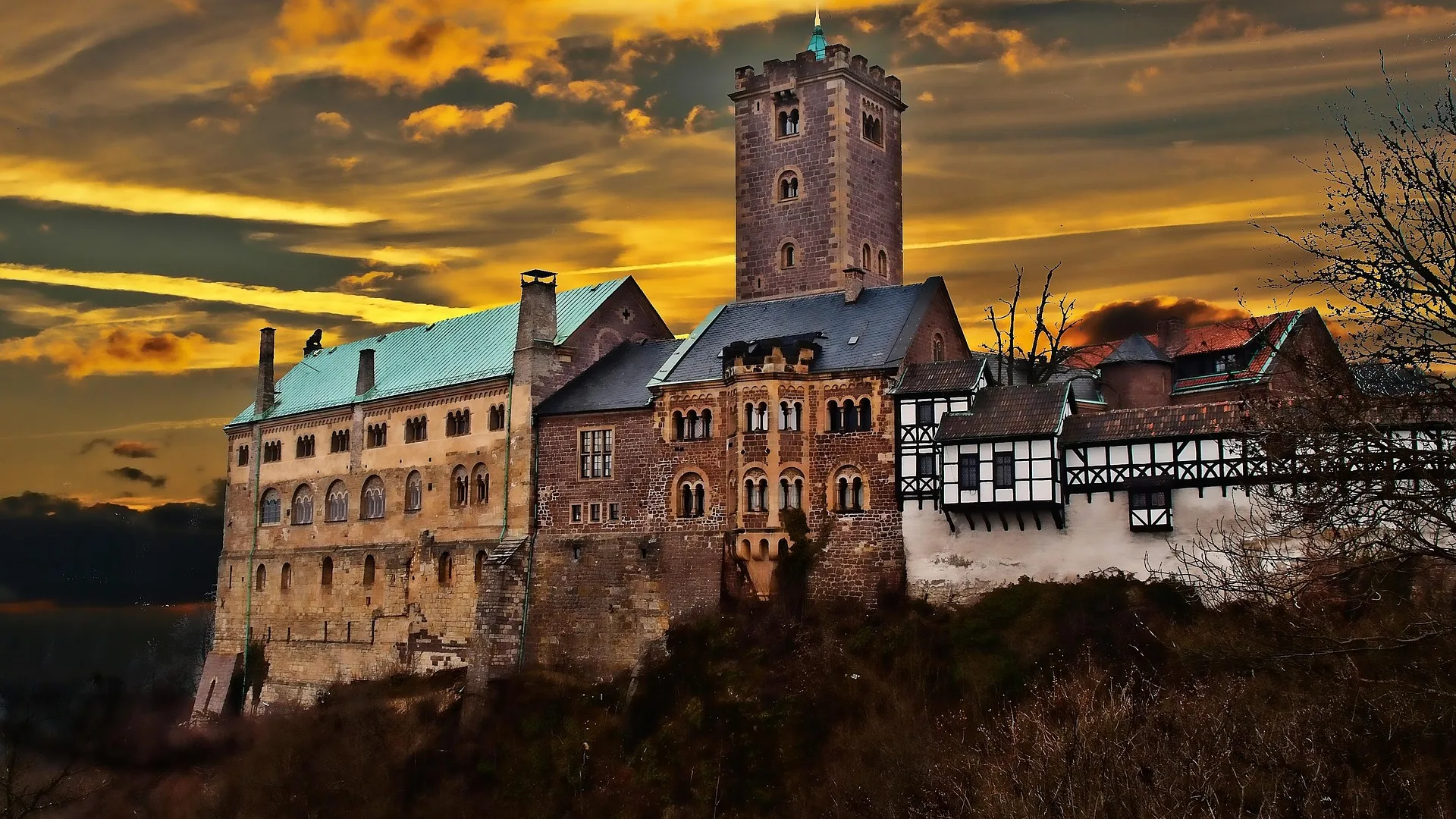
Between mid-September and the third week of October the Thuringian Forest turns through every shade of beech yellow and oak russet, and the Wartburg's hilltop position gives one of the best autumn-colour panoramas in central Germany. School holidays end in early September, English-tour availability stays at near-summer cadence into the first half of October, and visitor volume drops sharply mid-week. The low autumn sun catches the Romanesque sandstone of the Palas in the late afternoon between roughly 15:00 and 16:30, which is when most serious photographers plan their visit. Reformation Day on 31 October is a hard demand spike: Luther pilgrims, German school groups, and church-history tour operators all converge on the castle in the last week of October, and the English-tour grid sells out a week or more ahead. Either book that window early or sidestep it entirely for mid-October midweek, which is the quieter sister of late May.
Winter: the Advent castle
From November through March the Wartburg shifts to its winter schedule: shorter opening hours, a reduced English-tour grid, and occasional weather-driven closures when the steep cobble approach ices over. The castle stays open through most of winter but closes on Christmas Eve and Christmas Day, and the Wartburg-Stiftung publishes annual closure dates each November. The trade-off is atmosphere: the inner courtyard under snow, the Palas interior warm and quiet, and a Wartburg historic Christmas market in the courtyard on several Advent weekends each year, when stalls sell Thuringian gluehwein, hand-carved Erzgebirge wood figures, and roasted chestnuts under the medieval walls. Eisenach itself runs a parallel Christmas market on the Markt below from late November through 23 December. Winter visitors should plan to use the castle shuttle in both directions rather than walking the cobble path, dress for forest wind on the ramparts, and confirm the current English-tour schedule before booking train tickets.
Luther anniversary windows
Two recurring dates push the Wartburg's capacity hard every year and a third runs on multi-year cycles. Reformation Day on 31 October, which marks Luther's 1517 posting of the Ninety-Five Theses in Wittenberg, draws church-history pilgrims and German school groups to all Luther sites including the Wartburg, with the last week of October sold out well in advance. Luther's birthday on 10 November and his death-day on 18 February draw smaller but still notable bumps. Beyond annual dates, the Wartburg participates in major Luther anniversaries on roughly decadal cycles (the 2017 Reformation 500 year being the largest in living memory), and any year ending in -17 or -21 (the latter for the Wartburg-translation centenary, 1521-1522) is worth checking against the foundation's published programme. Visitors specifically interested in the Luther story do not need to time the trip to an anniversary, but anyone visiting during one should book the English-tour slot as early as the foundation's release window allows.
Frequently asked
What is the quietest month to visit the Wartburg?
February, outside the half-term week, is the annual low. The trade-off is shortened winter opening hours and a reduced English-tour grid, so confirm the current schedule before booking train tickets.
When does the Wartburg Christmas market run?
The Wartburg's historic Christmas market typically takes place across several Advent weekends in late November and December. Exact dates are published by the Wartburg-Stiftung each autumn.
Is the castle closed in winter?
No. The Wartburg stays open through winter on a reduced schedule but is closed on 24 and 25 December. Weather-driven short closures are rare but possible when the approach path ices.
When are English-language tours most frequent?
May through September is the peak English-tour cadence. Tours continue year-round but at reduced frequency in winter; the Wartburg-Stiftung publishes current schedules on wartburg.de.
Is Reformation Day (31 October) a good time to visit?
Only if you are specifically interested in the Luther pilgrimage atmosphere. The castle is at its busiest, English tours sell out well in advance, and the drawbridge queue is at an annual peak.
Does it snow at the Wartburg?
Yes. The ridge above Eisenach typically sees several snowfalls between December and February, and the courtyard under fresh snow is one of the most photographed winter scenes in Thuringia.
When does the donkey ride to the gate operate?
Donkey rides traditionally run on warm-weather days during the late spring and summer months. Schedules vary with weather; check wartburg.de or ask at the donkey station on the day.
What is the best time of day for photographs of the Palas?
Late afternoon between roughly 15:00 and 16:30 in autumn, when the low sun lights the Romanesque sandstone directly. Summer mornings give cooler, bluer light on the same elevation.
Should I avoid weekends?
If your dates are flexible, yes. Weekend volume runs notably higher than weekdays year-round, and the difference is sharpest in July, August, and the last week of October.