 Skip-the-line available
 Wartburg vs Neuschwanstein: A Visitor's Comparison
Romanesque history versus Romantic fantasy, Thuringia versus Bavaria, Luther's translation room versus Ludwig II's stage set.
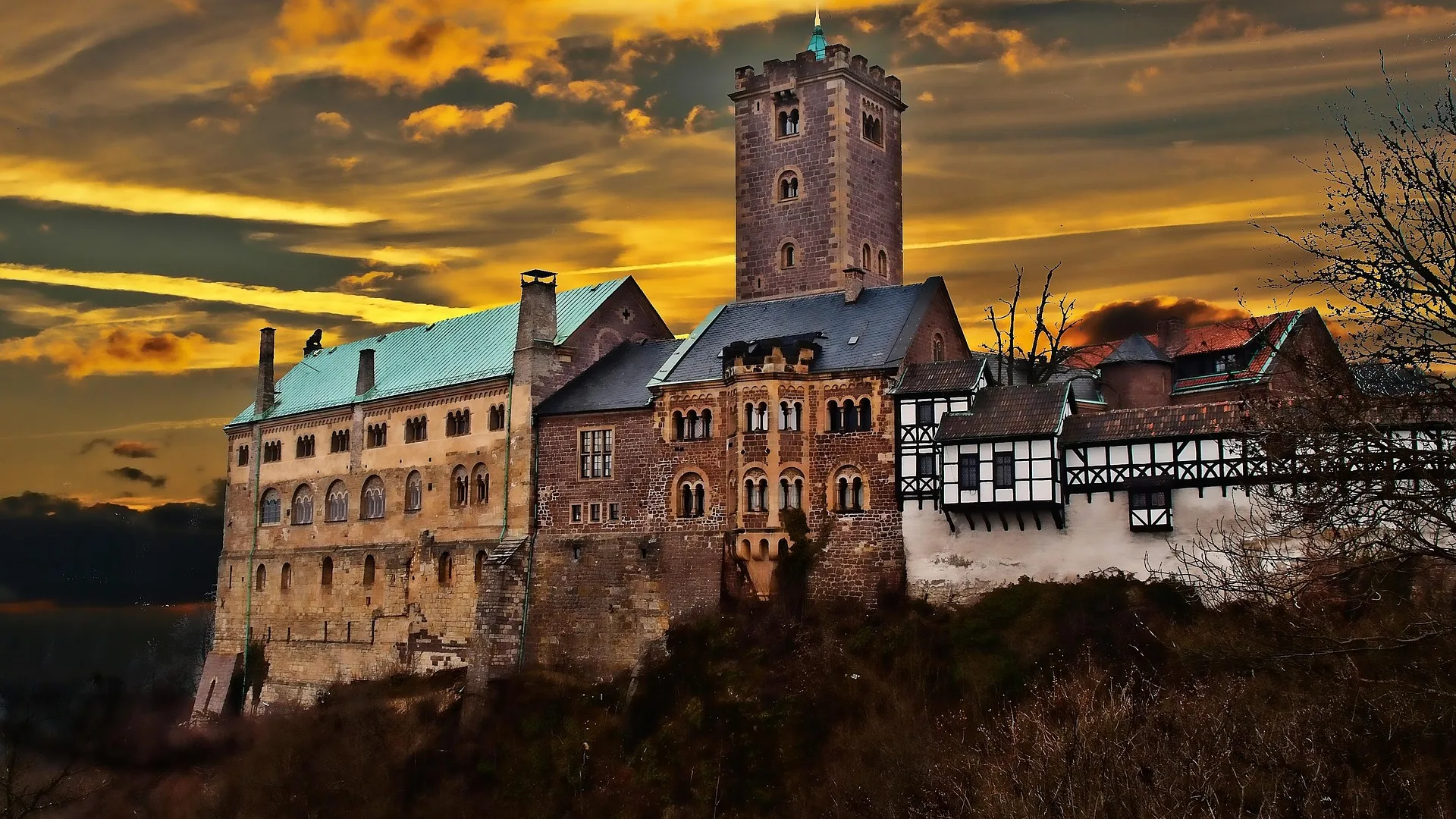
Wartburg Castle and Neuschwanstein Castle are the two most famous castles in Germany and the two most likely to appear on a visitor's shortlist, but they are very different places. The Wartburg, on a forested ridge above Eisenach in Thuringia, is a working medieval castle founded in 1067 and the room where Martin Luther translated the New Testament into German in 1521-22 — UNESCO-listed in 1999. Neuschwanstein, on a Bavarian hillside near Schwangau, is a 19th-century Romantic-historicist fantasy commissioned by King Ludwig II between 1869 and 1892 — UNESCO-listed in 2025 as part of the Palaces of King Ludwig II of Bavaria. This guide walks through the practical differences so you can choose the right one — or sequence both — for your trip.
History: 12th-century reality versus 19th-century theatre
The Wartburg is genuinely medieval. Founded in 1067 by Ludwig der Springer and continuously occupied for nearly a thousand years, its Palas (Great Hall) is the best-preserved Romanesque great hall in Germany and the rooms it contains carry real history: St Elisabeth of Hungary lived here as a young noblewoman between 1211 and 1228 before her canonisation in 1235, and Martin Luther translated the New Testament from Greek to German in this castle in roughly eleven weeks during his ten-month exile from 1521 to 1522. Neuschwanstein is theatrical history. Commissioned by King Ludwig II of Bavaria, foundation laid in 1869 and construction continuing until 1892, it was built as a private retreat and stage set inspired by medieval knights' castles and Richard Wagner's operas, including Tannhauser, Lohengrin, and Parsifal. Ludwig himself lived in the unfinished castle for only a few months before his death in 1886. Both are world-famous, but for opposite reasons: Wartburg for what really happened there, Neuschwanstein for what its creator imagined.
Architecture: Romanesque versus Romanesque Revival
The Wartburg Palas is a 12th-century Romanesque great hall built in coursed Thuringian sandstone, with the rounded arches, paired columns, and squat proportions characteristic of mid-Romanesque secular architecture. The 19th-century restoration under Grand Duke Carl Alexander of Saxe-Weimar-Eisenach rebuilt much of the surrounding precinct, but the Palas core is genuinely twelfth-century, and the Minnesingers' Hall and Elisabethkemenate sit inside that original shell. Neuschwanstein, by contrast, is a Neo-Romanesque historicist palace designed by stage designer Christian Jank and realised by the architects Eduard Riedel, Georg von Dollmann, and Julius Hofmann, who copied Romanesque forms and stretched them vertically into a fairy-tale silhouette: pointed towers, white limestone facing, and a 65-metre keep that Guinness World Records lists as the tallest castle in the world. Architecturally the Wartburg is what Neuschwanstein imitates, eight centuries earlier and at a calmer, more massive scale, with neither the verticality nor the alpine theatricality of Ludwig II's stage set above Hohenschwangau.
What you actually see inside
Inside the Wartburg the highlights are the Palas (Knights' Hall, Dining Hall, Chapel, Landgrave's Room), the Elisabethkemenate with its 1902-06 gold-mosaic decoration of the saint's life, the Minnesingers' Hall painted by Moritz von Schwind in 1854-55 with frescoes of the legendary medieval singing contest Wagner adapted in Tannhauser, the Luther Room with its plain wood-panelled walls and the famous 19th-century ink-splatter, and the Treasury. The interior is guided-tour-only and the tour runs about an hour. Inside Neuschwanstein the highlights are Ludwig II's Throne Room (designed but never used, with its Byzantine apse and chandelier), the Singers' Hall on the fourth floor inspired by the Wartburg's own Minnesingers' Hall, the Royal Bedroom with its hand-carved Gothic woodwork, and the artificial grotto. Tours are guided, around 30 minutes, and run continuously in multiple languages. Both castles ban interior photography variably; check current rules before visiting.
Practical visit: queues, climbs, transport
Both castles sit on hilltops and both require a final climb. From the Wartburg upper car park to the gate is a 10-15 minute cobble path with a castle shuttle alternative; from Hohenschwangau village to Neuschwanstein is a steeper 30-40 minute walk with horse-carriage and shuttle-bus alternatives. The Wartburg interior is accessed by timed guided tours that English-speakers should pre-book through the operator or a concierge, with an English tour grid that thins in winter. Neuschwanstein operates on a strict timed-entry system: tickets are sold by the Bayerische Schlosserverwaltung, English tours run frequently in summer, and missing your slot generally voids the ticket. Annual visitor numbers diverge sharply: Wartburg sees roughly 450,000 castle-interior visitors per year, while Neuschwanstein draws around 1.3-1.5 million with daily peaks reaching 6,000 in summer. Neuschwanstein queues are substantially heavier; the Wartburg is the calmer visit by a wide margin.
Which to choose, and can you do both?
Choose the Wartburg if you want a real medieval castle, the Luther story, the Thuringian Forest, English tour groups capped at small sizes, and a calmer day overall. Pair it with Eisenach (Bach-Haus, Lutherhaus, old-town Markt) and you have a full cultural day around a single rail hub. Choose Neuschwanstein if you want the postcard silhouette, the Bavarian Alps backdrop, the Ludwig II story, and the explicit Wagner connection. Pair it with the older Hohenschwangau castle next door and the Alpsee lake for a full day. Doing both on the same trip is realistic but not the same trip: the two castles are roughly 500 kilometres apart and most international itineraries sequence them with at least one major German city (Munich, Berlin, Frankfurt, or Leipzig) in between. The honest answer for first-time visitors with limited time is one, not both: pick the era and the story that interests you more, and give the chosen castle a full day.
Frequently asked
Which is older, the Wartburg or Neuschwanstein?
The Wartburg is roughly 800 years older. It was founded in 1067 and the Palas dates from the 12th century. Neuschwanstein's foundation stone was laid in 1869.
Are both UNESCO World Heritage Sites?
Yes. The Wartburg was inscribed in 1999 (ref 897). Neuschwanstein was inscribed in 2025 as part of the Palaces of King Ludwig II of Bavaria.
Which castle has more visitors per year?
Neuschwanstein, by a wide margin. Around 1.3-1.5 million per year versus roughly 450,000 paid castle-interior visitors at the Wartburg.
Can I visit both in one day?
Practically no. The two castles are around 500 kilometres apart and on different rail corridors; sequencing them requires at least two days plus a transfer city.
Which has the better Luther connection?
The Wartburg, decisively. Luther translated the New Testament here in 1521-22. Neuschwanstein has no Luther connection; its themes are medieval romance and Wagner.
Which has the more dramatic exterior?
Neuschwanstein. Its white limestone towers against the Bavarian Alps are the most-photographed castle exterior in Europe. The Wartburg is more massive and earthbound.
Which is harder to visit logistically?
Neuschwanstein, mainly because of volume. Timed-entry slots sell out far ahead in summer and the Hohenschwangau approach is heavily congested. The Wartburg is the calmer experience.
Which is closer to Munich?
Neuschwanstein, about 2 hours from Munich by train and bus via Fussen. The Wartburg is roughly 4 hours from Munich on the corridor through Frankfurt or Wurzburg.
Are interior photos allowed?
Photography rules vary at both castles and change periodically. Check current rules on wartburg.de and the Bayerische Schlosserverwaltung site before visiting; commercial photography requires advance permission at both.