 Skip-the-line available
 What to See Inside Wartburg Castle: A Room-by-Room Guide
Luther's translation cell, the Romanesque Palas, the Minnesingers' Hall, and the Elisabeth rooms — the highlights of the guided interior tour.
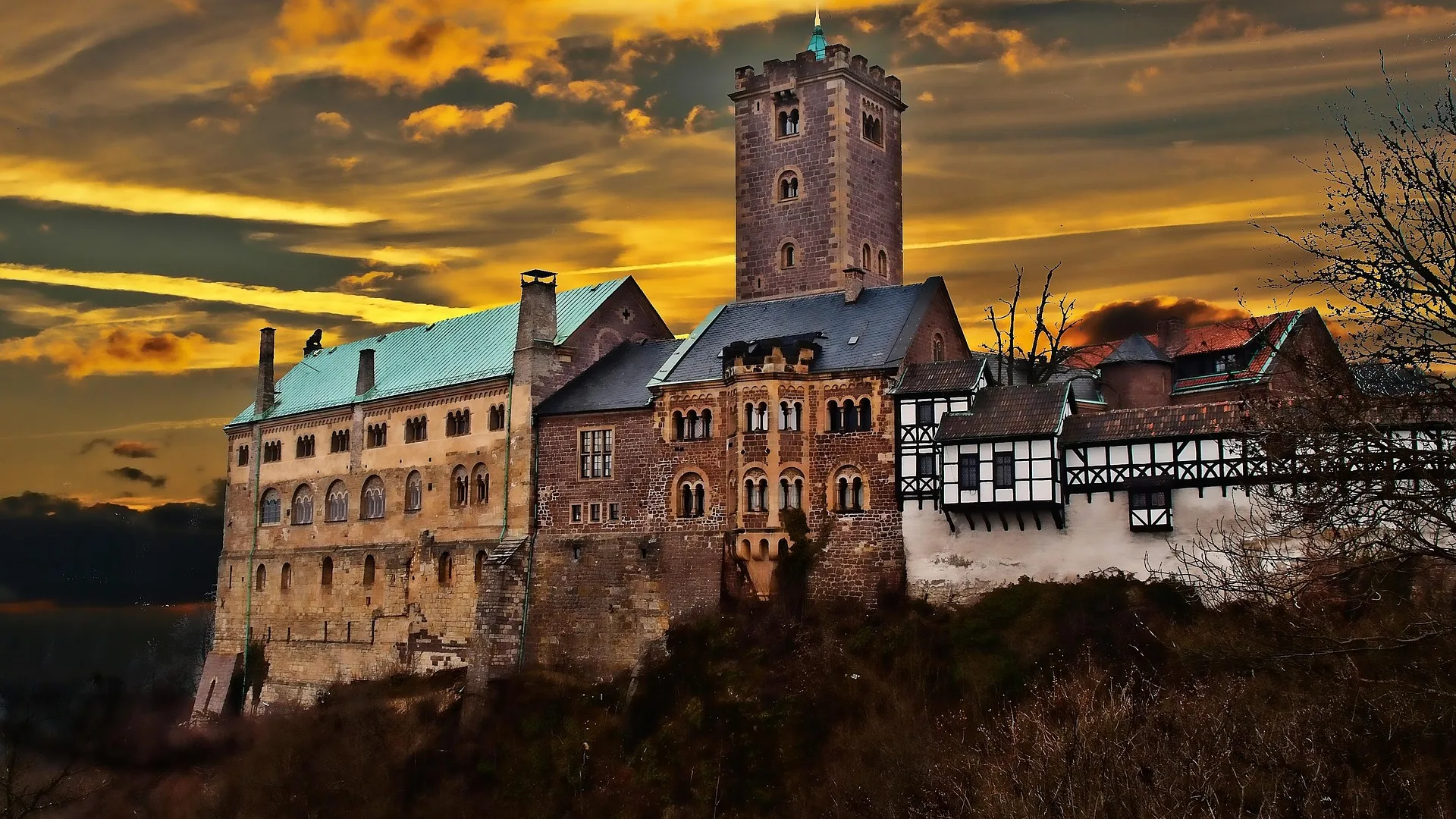
The Wartburg interior is guided-tour-only at most times, and the tour follows a fixed route through five clusters of rooms that together carry nine hundred years of German history. The Palas is the 12th-century Romanesque core; the Elisabethkemenate honours the 13th-century saint who lived here; the Minnesingers' Hall is a 19th-century painted hall dramatising a legendary medieval song contest; the Luther Room is the spartan cell where the Reformation's most consequential translation happened; and the Treasury holds the foundation's collection of medieval and early-modern art. This guide walks you through the route in the order the Wartburg-Stiftung tour leads you, so you know what you are looking at and why each room matters.
The Palas: Romanesque great hall
The Palas is the 12th-century Romanesque residential and ceremonial core of the Wartburg and the single most historically important structure on the site. Built between roughly 1160 and 1180 in Thuringian sandstone, it survives as the best-preserved Romanesque great hall in Germany, with the original load-bearing walls, paired column arcades, and Knights' Hall arcade arches all from the late twelfth century. The tour enters on the ground floor through the Knights' Hall, climbs to the Dining Hall and Chapel on the first floor, and reaches the Landgrave's Room and the Singers' Hall on the second. Throughout, the proportions are squat and dark in the medieval manner: thick walls, deep window splays, and small openings designed for defence as much as light. The 19th-century restoration repainted ceilings and recreated furnishings, but the stone shell and architectural skeleton are genuine medieval fabric. Standing in the Knights' Hall arcade is the closest most visitors will come to a 12th-century interior.
The Elisabethkemenate: St Elisabeth's rooms
St Elisabeth of Hungary (1207-1231) is the most-painted saint in German art and the patron of the Wartburg's medieval golden age. Sent to the castle around 1211 as a child betrothed to the future Ludwig IV of Thuringia, she lived here until her husband's death in 1227, becoming famous in her short life for her care of the poor and sick. She was canonised in 1235, remarkably soon after her death at age 24. The Elisabethkemenate (Elisabeth's bower) inside the Palas was redecorated between 1902 and 1906 with a spectacular gold-mosaic cycle by August Oetken depicting the saint's life, including the famous Miracle of the Roses in which the bread she was carrying to the poor turned to roses when her husband demanded to see what she hid. The mosaics are Jugendstil at its most opulent and sit inside genuine medieval walls. The chapel next door is also part of the original Palas and is used occasionally for ecumenical services.
The Minnesingers' Hall: Wagner's source
The Minnesingers' Hall (Sangersaal) on the upper floor of the Palas is the centrepiece of the 19th-century romantic restoration of the Wartburg. Between 1854 and 1855, Moritz von Schwind painted a fresco cycle in the hall depicting the legendary Sangerkrieg, the medieval Minnesingers' Contest said to have taken place at the Wartburg around 1207 under Landgrave Hermann I, in which courtly poets including Walther von der Vogelweide and the legendary Heinrich von Ofterdingen competed in song. Whether the contest actually happened is debated by historians, but the legend was the source material Richard Wagner adapted in his 1845 opera Tannhauser, in which the title knight returns from the Venusberg to compete in the song contest at the Wartburg. Standing in the Sangersaal is the closest physical experience visitors get to the setting Wagner imagined. The frescoes themselves are at the height of German Romantic painting and worth study in their own right.
The Luther Room: where modern German was born
The Luther Room (Lutherstube) is a small, plain, wood-panelled cell in the bailiff's house of the Wartburg precinct, separated from the formal halls of the Palas. After Luther was declared an outlaw at the Diet of Worms in May 1521, his protector Frederick the Wise of Saxony staged a fake kidnapping and hid him at the Wartburg under the alias Junker Jorg. Luther stayed for ten months and in approximately eleven weeks translated the New Testament from Erasmus's Greek text into vivid, spoken German that ordinary people could read aloud — the translation that gave modern High German its form. The room visitors see preserves the spartan character of Luther's stay, though it was extensively restored in the 19th century. The desk and writing materials are 19th-century reconstructions; the original desk was broken up for relics in the 1500s. The famous ink-splatter on the wall, where Luther supposedly threw an inkwell at the devil, is almost certainly a 19th-century embellishment guides have refreshed for two centuries.
The Treasury and museum
The Treasury, together with the broader Wartburg museum, holds the foundation's collection of medieval and early-modern art accumulated since the 19th-century restoration. Highlights vary with rotation but typically include 16th-century portraits by Lucas Cranach the Elder and Younger (the family painted Luther repeatedly and several Cranach Luther portraits are in the Wartburg collection), medieval ivories and reliquaries, the Hungarian silver collection associated with St Elisabeth, and a selection of Reformation-period prints and broadsides. The museum runs along the courtyard and is included in the standard ticket. Unlike the Palas and Luther Room, the Treasury is self-guided, so visitors can spend as much or as little time as they want; serious museum-goers easily spend an hour here, while many tour-day visitors give it twenty minutes between the guided sections. The Bergfried, the castle's main tower, is visible from the courtyard; on days when it is open, climbing the Bergfried gives the best Thuringian Forest panorama on the precinct.
Frequently asked
How long is the guided interior tour?
Approximately one hour through the historic interior — Palas (multiple rooms), Elisabethkemenate, Minnesingers' Hall, and Luther Room — in small groups.
Can I take photographs inside?
Policies vary by room and change periodically. Tripods, drones, monopods, and selfie sticks are not permitted. Check current rules on-site or in advance with the Wartburg-Stiftung.
Is the Luther Room the actual room where Luther translated the Bible?
It is the room traditionally identified as Luther's cell, though it was extensively restored in the 19th century. The desk and inkwell are 19th-century reconstructions; the original desk was broken up for relics in the 1500s.
Is the famous ink stain real?
Almost certainly not. The ink-splatter where Luther supposedly threw an inkwell at the devil is widely understood as a 19th-century embellishment that guides have refreshed over two centuries.
Can I climb the Bergfried tower?
The tower base is accessible from the courtyard and may be climbable on certain days for panoramic forest views. Check on-site availability; the climb involves narrow steps.
How accessible is the interior?
Partly. Ground-floor courtyard areas and parts of the museum are step-free. The Palas upper floors, Luther Room, and Minnesingers' Hall are reached only by medieval staircases.
Is the Elisabethkemenate the room where St Elisabeth actually lived?
It is in the section of the Palas traditionally identified with her, with the 1902-06 gold-mosaic decoration commissioned to commemorate her life. The room is genuinely medieval; the mosaics are early 20th-century.
What is the order of rooms on the tour?
The standard route is Palas ground floor (Knights' Hall), upper floors (Dining Hall, Chapel, Landgrave's Room), Elisabethkemenate, Minnesingers' Hall, then the Luther Room in the bailiff's house. The Treasury is self-guided after.
Are large bags allowed inside?
No. Large backpacks, suitcases, and oversized bags must go in the cloakroom at the gate — the historic interior has narrow doorways and spiral staircases. Day-bags and small handbags stay with you.