 Skip-the-line available
 Luther and Elisabeth at the Wartburg: A History Guide
Two of medieval Germany's most consequential lives, both lived inside the same Thuringian castle three centuries apart.
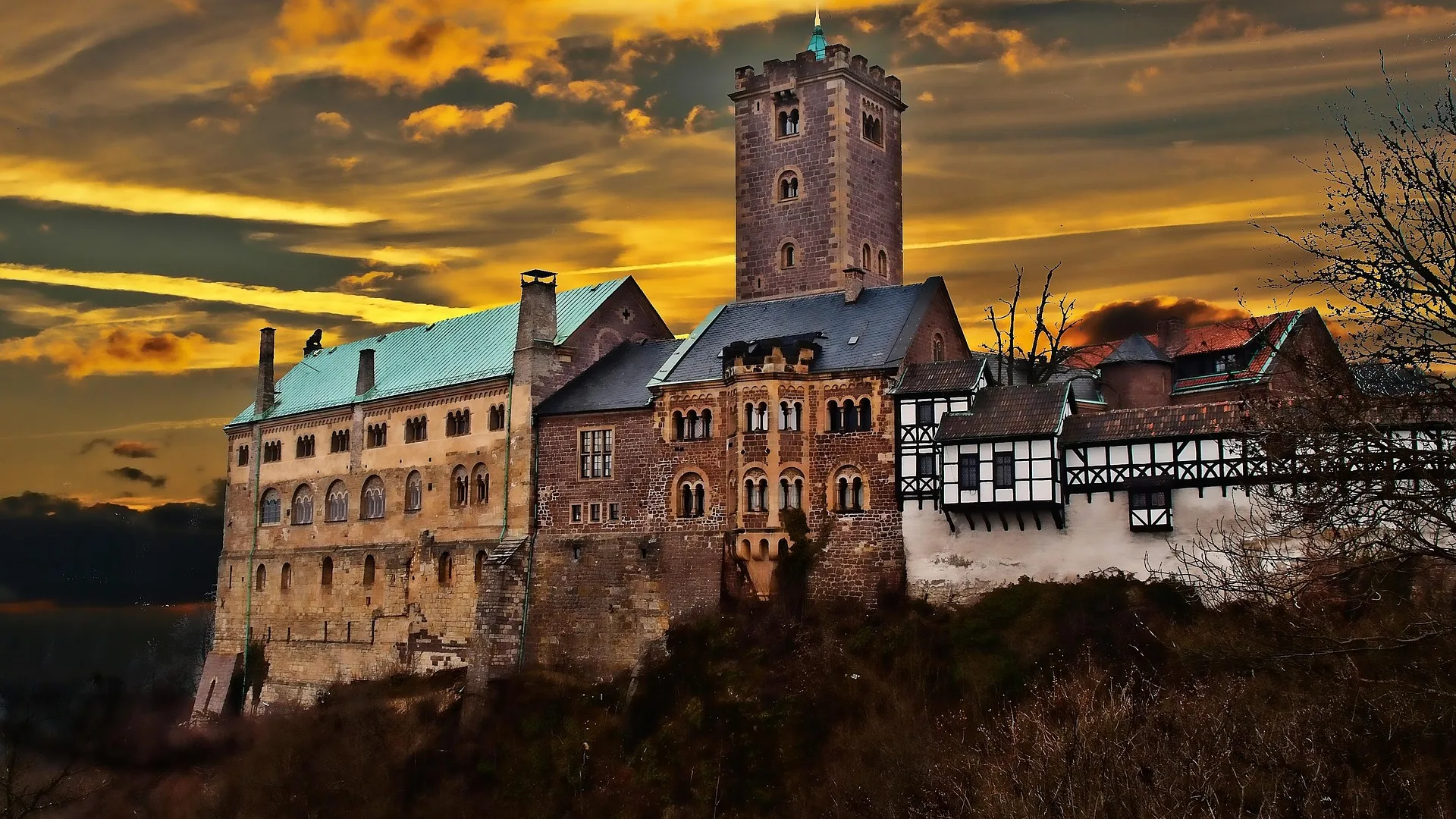
The Wartburg's UNESCO citation calls out two figures by name: Martin Luther, who translated the New Testament here in 1521-22 and effectively standardised the modern German language, and St Elisabeth of Hungary, who lived at the castle from around 1211 to 1228 and was canonised four years after her death at age 24. Both stories are embedded in the rooms visitors walk through today, and understanding them transforms the visit from a tour of old rooms into a walk through two of the most consequential lives in medieval and early-modern Germany. This guide tells both stories in plain order, with the legendary Sangerkrieg (the Minnesingers' Contest Wagner later dramatised) at the centre as the bridge between them.
Elisabeth: a Hungarian princess at the Wartburg
Elisabeth was born in 1207, daughter of King Andrew II of Hungary, and sent to the Wartburg around 1211 as a young child betrothed to the future Ludwig IV, Landgrave of Thuringia. She grew up at the castle, married Ludwig in 1221, and bore three children. Her short adult life at the Wartburg was shaped by an intense Christian devotion unusual for a noblewoman of her rank: she fasted, gave away her dowry to the poor, founded a hospital at the foot of the Wartburg ridge, and personally cared for lepers — acts captured a generation later in the legend of the Miracle of the Roses, in which the bread she carried to the poor turned to roses when her husband demanded to see what she hid. Ludwig died of plague on Crusade in 1227. Elisabeth, widowed at 20 and at odds with her in-laws over her continued charity, left the Wartburg and died at Marburg in 1231 at age 24. She was canonised in 1235.
The Sangerkrieg: a legendary singing contest
In roughly 1207, just before Elisabeth's arrival, the Wartburg was the court of Landgrave Hermann I, one of the leading patrons of medieval German lyric poetry. Tradition holds that around this time a Sangerkrieg — a singing contest between courtly Minnesinger poets — took place in the Wartburg, in which celebrated German vernacular poets including Walther von der Vogelweide, Wolfram von Eschenbach, and the half-legendary Heinrich von Ofterdingen competed for the Landgrave's favour. Modern historians regard the contest as more legend than verified fact, but the story carried weight through medieval German literature and was rediscovered by 19th-century Romantics. Richard Wagner adapted it as the central plot of his 1845 opera Tannhauser, in which the title knight returns from the Venusberg to compete at the Wartburg. The Minnesingers' Hall inside the Palas was painted by Moritz von Schwind in 1854-55 with frescoes of the contest — the literal stage for the legend visitors now stand in.
Luther's exile: the New Testament in eleven weeks
In April 1521 Martin Luther appeared before the Imperial Diet of Worms, refused to recant his writings, and was declared an outlaw of the Holy Roman Empire under the Edict of Worms. His protector, Elector Frederick the Wise of Saxony, staged a fake kidnapping on Luther's return journey and hid him at the Wartburg under the alias Junker Jorg (Knight George). Luther arrived on 4 May 1521 and stayed for roughly ten months, until 1 March 1522. He grew a beard, dressed as a knight, and worked in the small cell now known as the Lutherstube. In approximately eleven weeks between December 1521 and February 1522, he translated the entire New Testament from Erasmus's Greek edition into vivid spoken German — the September Testament, published in Wittenberg in September 1522. That translation is the foundation document of modern High German: Luther made deliberate vocabulary choices to favour the speech of ordinary people, and his text shaped German for five centuries.
The 19th-century revival: how the castle became a monument
By the early 19th century the Wartburg had decayed into a half-ruined administrative outpost, but two events brought it back into German cultural life. In 1817, on the 300th anniversary of Luther's Ninety-Five Theses, several hundred liberal-nationalist students from across the German states held the Wartburg Festival at the castle, an early demand for German unity and constitutional government that the conservative authorities suppressed. The festival made the Wartburg a symbol of liberal German identity. Then between 1838 and the 1890s, Grand Duke Carl Alexander of Saxe-Weimar-Eisenach commissioned a comprehensive restoration that rebuilt the precinct, refurnished the Palas, and commissioned the von Schwind frescoes in the Minnesingers' Hall and the gold mosaics in the Elisabethkemenate. Most of the castle visitors see today is genuine medieval fabric inside a 19th-century romantic envelope. The UNESCO inscription in 1999 recognised both layers: the 12th-century Palas as a Romanesque survival, and the 19th-century restoration as itself a significant monument of German Romantic historicism.
Why these stories still matter
Elisabeth and Luther share an unlikely castle and an unlikely common theme: both lived radically reformed lives inside the same building, both broke decisively with the social conventions of their class, and both produced cultural after-effects that lasted for centuries. Elisabeth's care of the poor was unusual enough for a 13th-century noblewoman that her own family resisted it, and her canonisation set a template of charitable royal sainthood that influenced European queenship for centuries. Luther's translation was so consequential that Goethe, three centuries later, said of him: 'We Germans simply do not know what we owe to Luther, both in language and in religion.' The Sangerkrieg legend connects the two: a 13th-century courtly poetry contest set in the same Palas, rediscovered by 19th-century Romantics, fed into Wagner's operas, and painted onto the walls visitors now stand inside. The Wartburg is rare in carrying three layers of consequential German history — Romanesque, Reformation, and Romantic — all in the same precinct.
Frequently asked
How long did Luther stay at the Wartburg?
Approximately ten months, from 4 May 1521 to 1 March 1522, under the alias Junker Jorg. He translated the entire New Testament in roughly eleven weeks during this period.
Did Luther really throw an inkwell at the devil?
Almost certainly not. The story and the ink stain on the wall are widely understood as a 19th-century embellishment that guides have refreshed over two centuries.
How old was Elisabeth when she came to the Wartburg?
Around four years old, betrothed to the future Ludwig IV of Thuringia in about 1211. She lived at the castle until her husband's death in 1227.
Why was Elisabeth canonised so quickly?
Her reputation for charitable work and the speed at which miracles were attributed to her at Marburg led to canonisation in 1235, just four years after her death at age 24.
Did the medieval singing contest really happen?
Historians generally treat the Sangerkrieg as legendary rather than verified fact, though the Wartburg was a major court for German lyric poetry under Landgrave Hermann I around 1207-1215.
What is the connection between the Wartburg and Wagner's Tannhauser?
Wagner adapted the legendary Sangerkrieg as the central plot of his 1845 opera Tannhauser, set explicitly at the Wartburg. The Minnesingers' Hall depicts the legendary contest in frescoes.
Which alias did Luther use at the castle?
Junker Jorg — Knight George. He grew a beard and dressed as a minor nobleman to remain unrecognised during his ten-month exile.
What was the 1817 Wartburg Festival?
A gathering of liberal-nationalist German students on the 300th anniversary of Luther's Ninety-Five Theses, calling for German unity and constitutional government. It made the castle a symbol of liberal German identity.
Are any original objects from Luther's stay on display?
Very few. Most of what visitors see in the Luther Room is 19th-century reconstruction. The original desk was broken up for relics in the 1500s; surviving Luther items are scattered across German collections.